Canva logo vs. brand system: when it's worth investing
Making your logo in Canva or with AI is fast and cheap, and it can work to get started. But it has legal and practical limits few people know about. Here's when it's enough and when it's time to move to a brand system, with the real case of Rebel Street.
Today anyone can make a Canva logo in an afternoon, or ask an AI for one in two minutes. It's fast, it's cheap and, for many entrepreneurs, it's the most logical way to start. I'm not against it: to validate an idea, show something to your first customers or open an Instagram account, it can be enough.
The problem shows up later. When you want to register your brand, print labels, embroider a garment, paint a storefront or make packaging, that logo starts falling short. Sometimes for design reasons, and sometimes for legal reasons almost nobody checks before starting. In this article I explain the difference between a template logo and a brand system, and how to tell when it's worth investing, with the real case of Rebel Street.
What Canva does solve
Let's be fair. A logo made in Canva or with AI has real advantages at the start:
- It's fast. You have something in hours, not weeks.
- It's cheap. If you don't know yet whether your idea will work, spending a lot doesn't make sense.
- It forces you to decide. Picking a name, a color and a style is already progress.
For a market test, a fair or your first posts, it does the job. The mistake is treating it as your final brand.
The limits almost nobody checks
You can't trademark it if it uses library content
This is the most important point and the least known. Canva's own licensing page says you cannot use any Free or Pro content from its library in a trademark. The exceptions are fonts, simple shapes and lines. In other words: if your logo uses an icon, an illustration or a graphic element from Canva's library, you can't register it as a trademark.
Without registration, someone else could register something similar and you'd have very little to defend yourself with. Before registering, talk to an intellectual property lawyer; I'm a designer, not a lawyer, but I do see many businesses find this out too late.
It isn't exclusive
The same Canva page makes it clear that template content isn't exclusive: other users are free to use the same content in their designs. Your logo could be almost identical to another company's, even one in your city or in your industry. AI generators have a similar issue: they tend to repeat styles and formulas, so it's easy to end up with a logo that looks like many others.
It works on screen, not always in the real world
A template logo is usually designed to look good in an Instagram square. But a brand lives at many sizes and on many materials: a storefront, embroidery, a cardboard tag, a stamp, a sticker. Fine details disappear when small, gradients can't be embroidered and colors shift in print.
What a brand system is
A brand system isn't "a more elaborate logo". It's the set of rules that makes your brand recognizable anywhere:
- The logo and its versions, for different backgrounds and sizes.
- A color palette with a hierarchy: what's the background, what's the accent and what's a detail.
- Typefaces with a clear use for headlines and text.
- Graphic assets, such as patterns, textures or icons that identify the brand even without the logo.
- Real applications: how it looks on the storefront, on packaging, on clothing or on social media.
- Brand guidelines that document everything. I explain what goes in them in what a brand guidelines manual includes.
You can see the difference on the street: a system makes ten different pieces feel like the same brand. A standalone logo, applied without rules, looks different every time.
The Rebel Street case
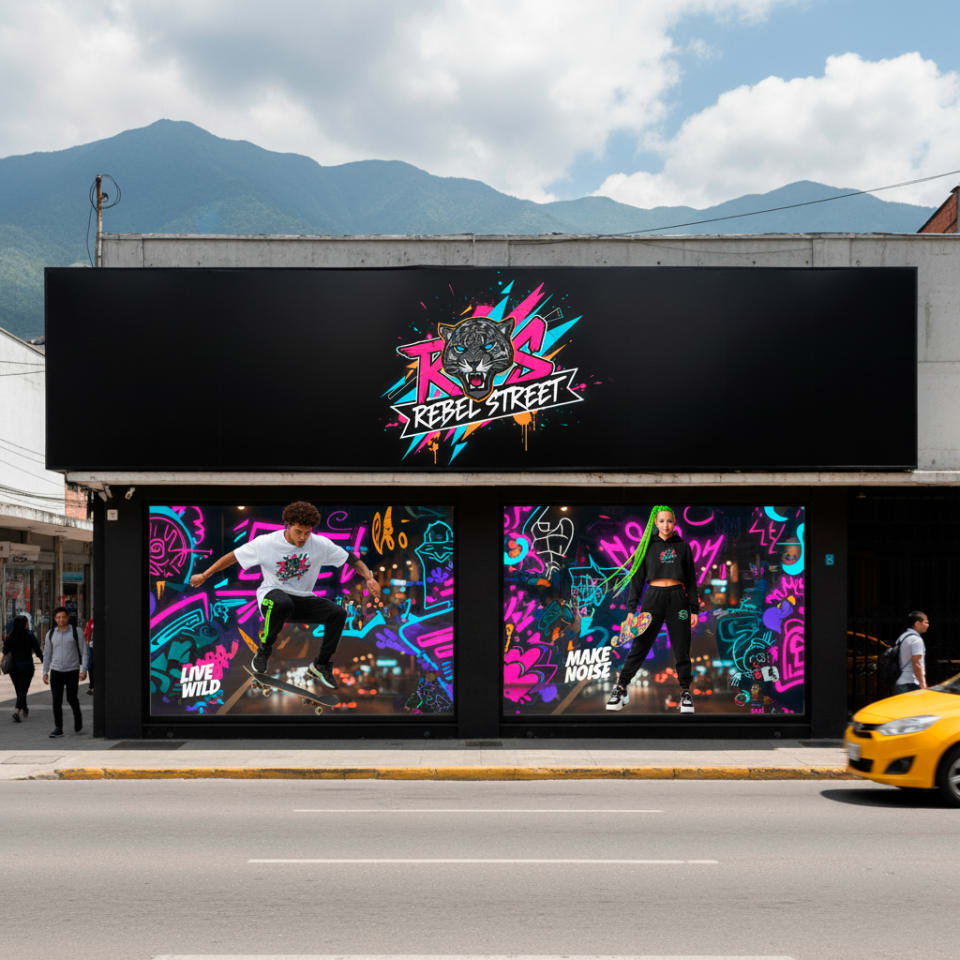
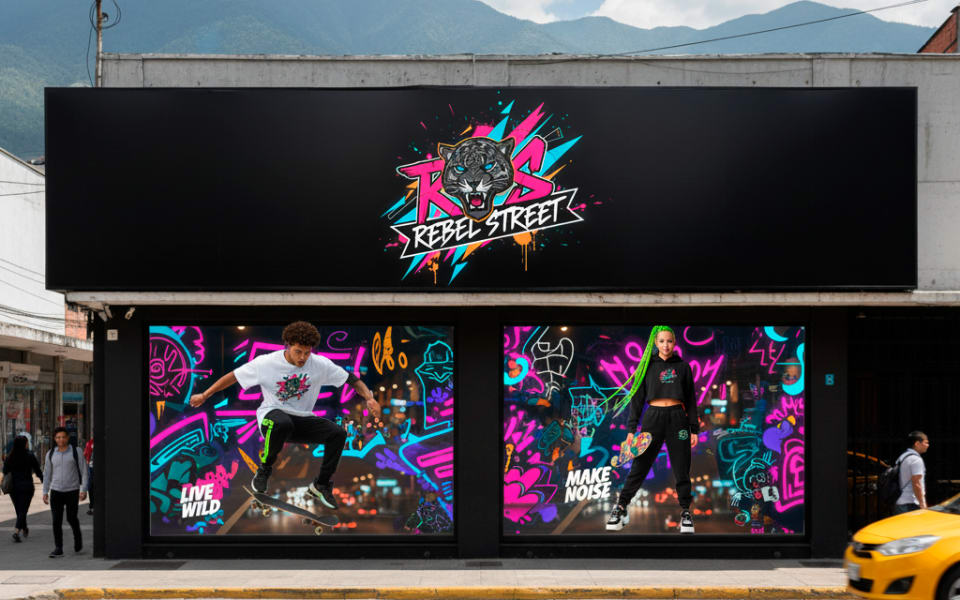
Rebel Street was an independent Bogotá entrepreneur's first brand. There was no store and no production yet, just an idea and a logo put together in Canva with help from AI. It was fine to show a friend, but not to put on a storefront, a label or the back of a hoodie.
The challenge was to design a system with street attitude, graffiti-inspired, that the right audience would recognize instantly, but with enough discipline to look just as solid on a 4-meter storefront as on a 3-centimeter label. That's why I defined the rules before designing the pieces: which elements repeat, how the logo behaves at each scale, which palette stays fixed and where there's room to vary.
The result was 9 pieces sharing the same identity:
| Piece | What it proves |
|---|---|
| Storefront | The logo works at large scale |
| Hoodie, joggers and oversize shirt | The brand can be worn, on fabric and in print |
| Staff uniforms | The people serving customers carry the brand too |
| Brand pattern | The element that repeats and anchors everything else |
| Label | It reads even at the smallest detail |
| Shopping bag | The experience starts before the garment is unwrapped |
| Thank-you card | The brand stays with the customer after the purchase |
"We wanted something urban, with a graffiti edge applied to streetwear. The identity came out exactly as we imagined it." — Steven Mesa, founder of Rebel Street
When it's worth investing in a brand system
Not every business needs one from day one. This is my rule of thumb:
Your Canva logo still works if:
- You're validating the idea and don't know if you'll still be going in six months.
- You sell online only, with few products and no physical production.
- You don't plan to register the brand yet.
It's time to invest in a system if:
- You're going to produce something physical: clothing, packaging, labels, a store or a vehicle.
- You're going to register the brand.
- You're going to work with several suppliers, such as printers, garment makers or a social media manager.
- You compare yourself with competitors and your brand looks the same or more improvised.
- You're going to raise investment, look for distributors or get into retail stores.
The key is to invest before you produce. Redesigning after printing a thousand labels or painting a storefront costs much more than getting it right first.
How to go from a Canva logo to a brand of your own
- Keep what works. If your customers already recognize a color or a name, you don't have to start from scratch.
- Define where the brand will live. List every application: social media, packaging, storefront, clothing, stationery.
- Design the whole system, not just a new logo: versions, color, typography and assets.
- Test at extreme sizes before producing. Print the logo small and look at it big from a distance.
- Document everything in guidelines and hand the files to your suppliers.
- Register the brand once the design is original and final.
If you have a logo made in Canva or with AI and feel your brand has fallen short, see how I approach visual identity. I can turn your idea into a system ready for the street, the printer and the trademark office.
Frequently asked questions
Can I trademark a logo made in Canva?
Under Canva's license, you can't use Free or Pro content from its library in a trademark; the exceptions are fonts, simple shapes and lines. If your logo uses icons or illustrations from the library, you won't be able to register it. Talk to an intellectual property lawyer before you do.
Is a logo made with AI exclusive?
There's no guarantee. AI generators tend to repeat styles and formulas, and Canva templates aren't exclusive, so another business can end up with a logo very similar to yours.
What's the difference between a logo and a brand system?
The logo is one piece. A brand system includes the logo and its versions, a palette with a hierarchy, typography, graphic assets, applications and the guidelines that explain how to use it all.
When should I invest in a brand system?
Before you produce something physical like clothing, packaging, labels or a store, before you register the brand, or when you start working with several suppliers. Redesigning after production costs much more.
Do I have to start from scratch if I already have a Canva logo?
Not necessarily. If your customers already recognize a name, a color or an idea, a good system can start from there and turn it into an original design you can register.