How to launch a brand on social media without relying on a huge ad budget
When a new brand hits the market, nobody knows it or trusts it yet. Here's the method I used to launch DiaDent at Orbidental: a visual system first, content second, and ads that amplify what already works.
Launching a brand on social media sounds simple: you open an account, post a few product photos and pay so more people see them. In practice, almost every launch that fails does so for the same reason: the brand goes out into the world without a recognizable face, and the ads end up showing thousands of people something they forget five seconds later.
In September 2026 I launched DiaDent, a dental brand joining the portfolio of Orbidental, a dental supply distributor in Colombia. No dentist had tried it yet. My job was to make them recognize it, understand it and want to order it before the first sale. In this article I walk you through the method step by step, so you can apply it to your own brand, whether it's in healthcare, food or fashion.
Why most social media launches don't work
A new brand has a problem an established brand doesn't: nobody trusts it yet. With DiaDent it was very clear. Dentists already have a material in their practice that works. If the new brand shows up with improvised posts, nobody is going to risk a treatment on something that looks generic.
These are the mistakes I see most often:
- Posting one-off pieces. Every post has a different style because it was designed the same day it went out. The brand never becomes recognizable.
- Talking about price before value. A discount in the first week tells customers the product needs a markdown to sell.
- Putting all the money into ads. Paid media amplifies what already exists. If the content doesn't stop the scroll, you pay for more people to ignore it.
- Having no content plan. Things get improvised week by week and the launch fades into a month of posts with no thread.
Step 1: define a visual system before designing the first piece
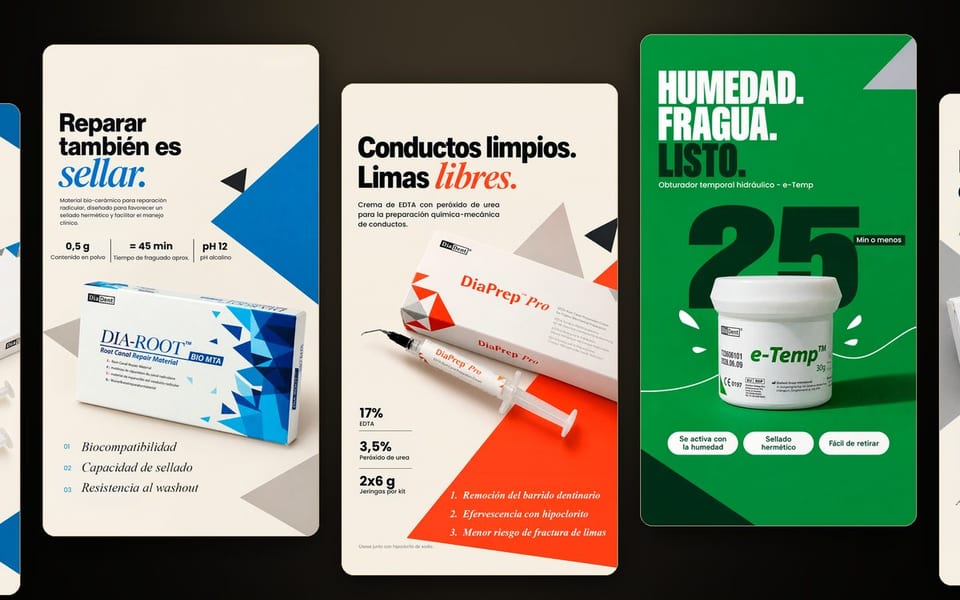
The first thing I did for DiaDent wasn't a post. It was a system. I took the triangles the brand already used on its packaging and made them the hero: at monumental scale, on an off-white background, with a different color for each product. The product changes, but the brand stays instantly recognizable.
A good visual system for social media defines four things:
- A graphic element that repeats in every piece. It can come from the logo, the packaging or the product itself.
- A palette with rules: which color is the background, which one is the accent and which one identifies each product or line.
- A fixed text hierarchy: where the headline goes, where the technical data goes and where the brand goes.
- A tone of voice: how the brand sounds when it speaks.
If you want to go deeper into what makes up an identity, I explain it in what a brand guidelines manual includes. For a social media launch, those four decisions are the foundation.
Step 2: write headlines that sell an idea, not a deal
Every DiaDent product got a headline that works as a brand idea: "Clean canals. Free-moving files.", "Repairing is sealing too.", "Moisture. Set. Done." None of them say "buy now" or "special price". They say what problem the product solves, in the words dentists use every day.
Under the headline goes the technical data, checked against the manufacturer's information and presented as a spec sheet, never as a promotion: percentages, setting times, sizes. In a professional field, well-presented data builds more trust than any adjective.
The rule works for any brand: the headline sells the idea and the data backs it up. If you sell coffee, the headline talks about the moment you drink it and the data tells the origin or the roast.
Step 3: put together a small, complete launch kit
You don't need 60 posts to launch a brand. For DiaDent, the full kit was this:
| Piece | Quantity | What it's for |
|---|---|---|
| Launch video | 1 landscape and 1 vertical, 18 seconds | Introduce the brand and its lines on the web, screens, reels and stories |
| Product stories | 8, in 9:16 format | Show each product with the same visual system |
| Product reels | 6 plus one animation | Explain each product in sync with the music |
| Products featured | 13 | Cover the whole initial portfolio |
Everything came from the same system, so the sales team could use the pieces the very next day on WhatsApp, on the website and on social media. Having the same person do design and video helps a lot: nobody has to translate the style between two suppliers.
Step 4: produce photos and videos you can repeat
For several DiaDent pieces I shot the product photos myself. You don't need a big studio, but you do need a rule: same background, same light and same framing across the whole catalog. That way every new product fits the system without redesigning anything.
In video, the key was editing in time with the music: every scene change lands where the message changes. Concept first, then the number that backs it up. A 30- to 60-second reel with one idea per scene is easy to follow without pausing, even with the sound off.
Step 5: post in order, not in a rush
A simple launch calendar has three moments:
- Week 1, the announcement. The launch video and a story explaining what's arriving and why it matters.
- Weeks 2 and 3, product by product. One story and one reel per product, with the same system. Repetition is what makes the brand stick.
- Week 4 onward, social proof. Feedback from the first customers, frequently asked questions and the product in use.
Don't post everything on the same day. Every new piece reminds customers the brand is active.
Step 6: use ads to amplify, not to fix
Ads work best when the content has already proven people care about it. My approach is to let the pieces circulate for a few days, see which ones get the most saves, messages and clicks, and put the budget behind those.
In the Meta Ads campaigns I run for Orbidental we reached 626 B2B leads at about 0.61 USD each, with a 1.61% CTR. It wasn't about spending more: the ads used well-designed pieces and a clearly defined audience. In the social media work for Orbidental and Biotec, design plus well-targeted ads delivered 179K+ impressions and a 1,300% lift in clicks to the website in four months. I cover it in more detail in the Social Media Dental case.
Step 7: measure what matters
Likes tell you very little about whether a launch is working. Look at this instead:
- Saves and shares: they show the content is useful or worth showing someone else.
- Direct messages and conversations: in B2B sales and local businesses, that's where buying starts.
- Clicks to your site or WhatsApp: they measure real intent.
- Cost per result, if you run ads: how much you pay per conversation or lead, not per view.
Check these numbers every week during the first month and use them to decide which product to push.
Checklist for launching your brand
- A graphic element that repeats in every piece.
- A palette with rules and one color per product or line.
- Headlines that are brand ideas, not discounts.
- Photos with the same background, light and framing.
- One launch video, plus one story and one reel per product.
- A four-week calendar.
- Ads only behind the pieces that already work.
- Intent metrics: messages, clicks and cost per result.
If you're launching a brand or adding a new line to your catalog, I can help with the visual system, the content and the video. See how I handle graphic design and social media or message me and I'll tell you what I'd do first in your case.
Frequently asked questions
How much content do I need to launch a brand on social media?
For a one-month launch, one launch video, one story and one short reel per product or line, plus a few social proof pieces, are enough. A small kit with a solid visual system beats lots of disconnected posts.
Do I have to pay for ads to launch a brand?
It isn't required, but it speeds up results. Ideally, post first, see which pieces get saves, messages and clicks, and put the budget behind those. Ads amplify good content; they don't fix content that doesn't work.
Which social network is best for a launch?
The one your customers already use. For consumer brands and local businesses in Latin America, Instagram is usually the base, with WhatsApp to close the sale. For B2B sales, Meta Ads campaigns that lead to a conversation also work very well.
How long does it take to prepare a launch?
It depends on the number of products, but a visual system with stories and videos for a portfolio of 8 to 13 products can be ready in a few weeks when one person handles design, photography and editing.
How do I know if my launch worked?
Look at intent, not just reach. Direct messages, clicks to your site or WhatsApp, saves and cost per result tell you whether the brand is generating real interest.